Zespan observability for ADK
Zespan is an agent reliability platform for AI applications. The Zespan SDK instruments ADK agents natively by capturing every agent invocation, model call, tool execution, and multi-agent delegation as linked spans, then shipping them to the Zespan dashboard for inspection, cost attribution, and evaluation.
Overview
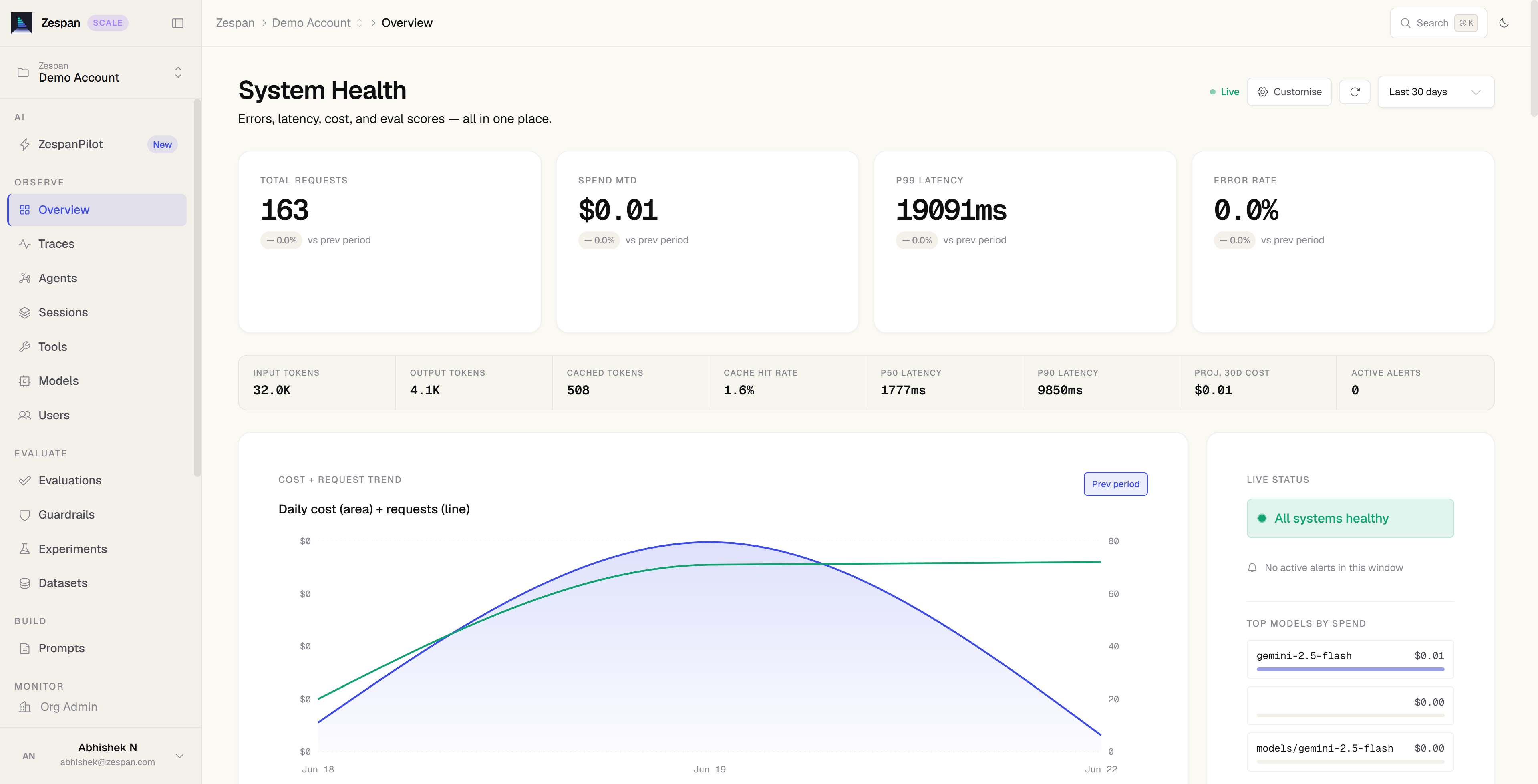
Once your ADK agents are instrumented, the Zespan platform provides:
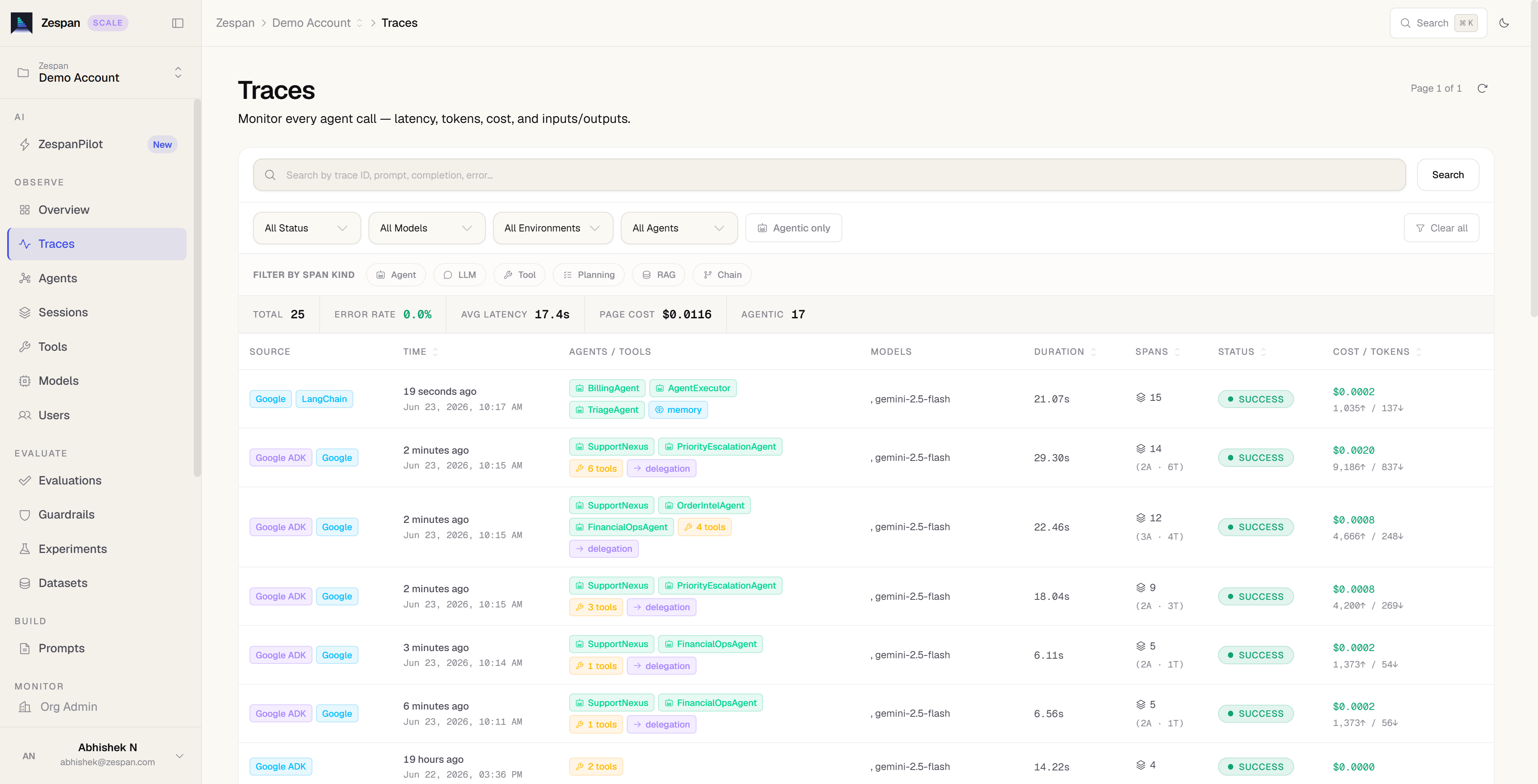
- Tracing: Capture every agent, model, tool, and delegation span with latency, tokens, and cost.
- Cost attribution: Break down spend by model, agent, and time period.
- Evaluations: Score agent behavior with custom metrics, datasets, and simulations.
- Guardrails: Block, redact, or flag unsafe inputs and outputs at runtime.
- Prompt management: Fetch and version prompts with caching and variable substitution.
Prerequisites
Before you begin, set up a Zespan account and credentials:
- Sign up at app.zespan.com.
- Create a project and copy the API key from Onboarding → API Key.
- Set the environment variables:
Installation
Install the Zespan SDK alongside ADK:
Send traces
Instrument an ADK agent with the Zespan SDK to start capturing traces:
Initialize Zespan once at startup, then create a ZespanADKCallbackHandler
and spread its .callbacks into your LlmAgent.
import asyncio
import os

import zespan
from zespan import ZespanADKCallbackHandler
from google.adk.agents import LlmAgent
from google.adk.runners import InMemoryRunner
from google.genai import types

zespan.init(api_key=os.environ["ZESPAN_API_KEY"])

handler = ZespanADKCallbackHandler()


def get_weather(city: str) -> dict:
    """Retrieves the current weather report for a specified city."""
    if city.lower() == "new york":
        return {
            "status": "success",
            "report": "The weather in New York is sunny with a temperature of 25°C.",
        }
    return {
        "status": "error",
        "error_message": f"Weather information for '{city}' is not available.",
    }


agent = LlmAgent(
    name="weather_agent",
    model="gemini-flash-latest",
    description="Agent to answer weather questions.",
    instruction="Use the available tools to find an answer.",
    tools=[get_weather],
    **handler.callbacks,
)


async def main():
    runner = InMemoryRunner(agent=agent, app_name="weather_app")
    await runner.session_service.create_session(
        app_name="weather_app", user_id="user", session_id="session"
    )
    async for event in runner.run_async(
        user_id="user",
        session_id="session",
        new_message=types.Content(
            role="user",
            parts=[types.Part(text="What is the weather in New York?")],
        ),
    ):
        if event.is_final_response():
            print(event.content.parts[0].text.strip())


if __name__ == "__main__":
    asyncio.run(main())
Two approaches are available.
instrumentADK wraps coordinator and runner in one call and intercepts
the full event stream, including delegations.
import { zespan, instrumentADK } from "@zespan/sdk";
import { LlmAgent, InMemoryRunner } from "@google/adk";

zespan.init({ apiKey: process.env.ZESPAN_API_KEY! });

function getWeather(city: string): object {
  if (city.toLowerCase() === "new york") {
    return {
      status: "success",
      report: "The weather in New York is sunny with a temperature of 25°C.",
    };
  }
  return {
    status: "error",
    error_message: `Weather information for '${city}' is not available.`,
  };
}

const coordinator = new LlmAgent({
  name: "weather_agent",
  model: "gemini-flash-latest",
  description: "Agent to answer weather questions.",
  instruction: "Use the available tools to find an answer.",
  tools: [getWeather],
});

const runner = new InMemoryRunner({
  agent: coordinator,
  appName: "weather_app",
});

const { runner: tracedRunner } = instrumentADK({ coordinator, runner });

for await (const event of tracedRunner.runEphemeral({
  userId: "user",
  newMessage: { parts: [{ text: "What is the weather in New York?" }] },
})) {
  if (event.isFinalResponse()) {
    console.log(event.content.parts[0].text);
  }
}
ZespanADKCallbackHandler uses ADK's native callback system; spread
.callbacks into your agent config.
import { zespan, ZespanADKCallbackHandler } from "@zespan/sdk";
import { LlmAgent, InMemoryRunner } from "@google/adk";

zespan.init({ apiKey: process.env.ZESPAN_API_KEY! });

const handler = new ZespanADKCallbackHandler();

const agent = new LlmAgent({
  name: "weather_agent",
  model: "gemini-flash-latest",
  description: "Agent to answer weather questions.",
  instruction: "Use the available tools to find an answer.",
  tools: [getWeather],
  ...handler.callbacks,
});

const runner = new InMemoryRunner({ agent, appName: "weather_app" });

for await (const event of runner.runEphemeral({
  userId: "user",
  newMessage: { parts: [{ text: "What is the weather in New York?" }] },
})) {
  if (event.isFinalResponse()) {
    console.log(event.content.parts[0].text);
  }
}
Multi-agent systems
Zespan links coordinator and sub-agent spans into a single trace:
Use the same handler instance across the coordinator and all sub-agents. Spans are linked under a single trace via the shared ADK invocation ID.
With instrumentADK, all subAgents are wrapped recursively and automatically.
const specialist = new LlmAgent({
  name: "lookup_agent",
  model: "gemini-flash-latest",
  tools: [lookupTool],
});

const coordinator = new LlmAgent({
  name: "coordinator",
  model: "gemini-flash-latest",
  subAgents: [specialist],
});

const { runner: tracedRunner } = instrumentADK({
  coordinator,
  runner: new InMemoryRunner({ agent: coordinator, appName: "my_app" }),
});
With ZespanADKCallbackHandler, spread the same instance into every agent.
const handler = new ZespanADKCallbackHandler();

const specialist = new LlmAgent({
  name: "lookup_agent",
  model: "gemini-flash-latest",
  tools: [lookupTool],
  ...handler.callbacks,
});

const coordinator = new LlmAgent({
  name: "coordinator",
  model: "gemini-flash-latest",
  subAgents: [specialist],
  ...handler.callbacks,
});
View traces in the dashboard
Run the agent, then open your project at app.zespan.com. Each ADK run produces a hierarchical trace showing:
- Agent spans with latency and delegation links between coordinator and sub-agents
- LLM spans with token counts, cost, finish reason, and optional prompt/completion text
- Tool spans with input arguments and return values